How many hours does it take to become a competent needler?
This is an important question for all dry needling therapists, educators, regulators and professional bodies.
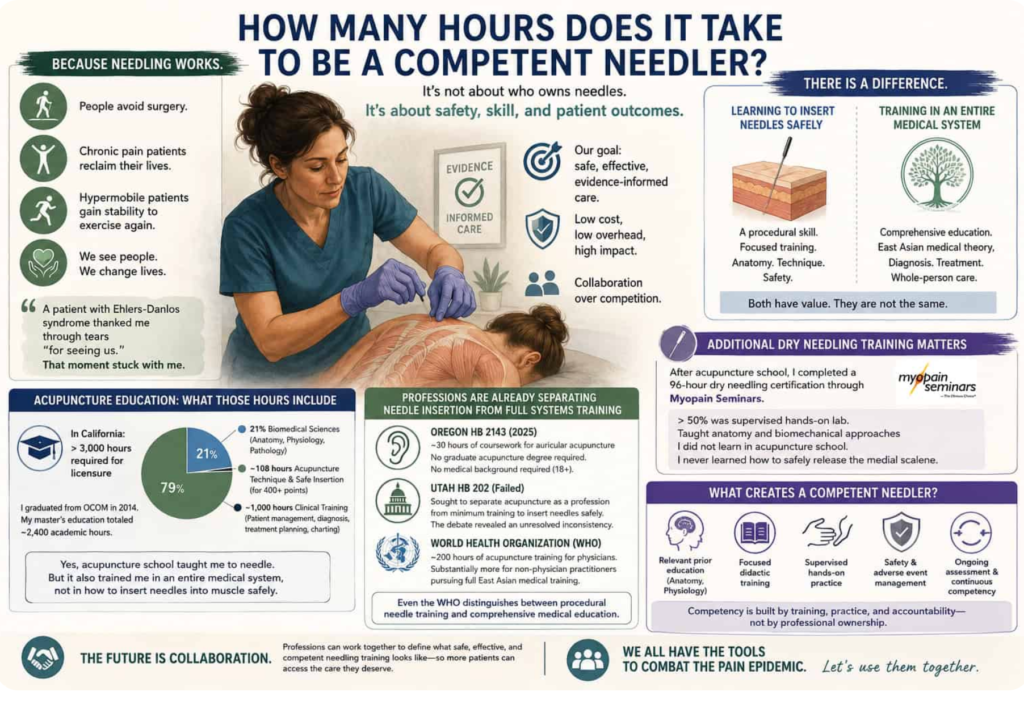
An interesting article by Sarah Hammer Stevens, a licensed acupuncturist who also trained in dry needling, challenges the idea that competence should be judged simply by the total number of hours in a professional programme.
Her key point is that not all education hours are the same. Acupuncture training may involve thousands of hours, but only a portion of those hours are specifically focused on needle insertion, needling safety, anatomy, and technique. Much of the education, quite rightly, teaches a complete medical system, including diagnosis, theory, treatment planning, and clinical reasoning.
Dry needling training, by contrast, should be judged on whether it provides clear, supervised, competency-based education in anatomy, safety, clinical reasoning, risk management and practical needle technique.
For dry needling therapists, this article is useful because it moves the discussion away from professional “ownership” of needles and towards the issue that matters most: can the practitioner needle safely, effectively and within their professional scope?
The future of needling education should not be based on turf wars. It should be based on high standards, clear competencies, supervised practical training and patient safety.
That is a conversation all needling professions should be willing to have.
Source: Myopain Seminars article, “How Many Hours Does It Take to Be a Competent Needler?”